

The message from the JW Marriott halls was clear: Africa is no longer a spectator in global climate agendas but is now positioning its timber, biodiversity and carbon assets as the primary engine for regional competitiveness and sovereign growth.
The inaugural Zámba Heritage Congress, convened by the Forest Stewardship Council (FSC®) in partnership with the Government of Kenya, opened on 10 February 2026 at the JW Marriott Hotel, bringing together ministers and senior forestry officials from 14 African countries, alongside regional institutions, Indigenous Peoples’ representatives, civil society, researchers, and private sector actors. Day 1 marked more than the start of a Congress. It signaled the consolidation of political resolve, institutional coordination, and market alignment around a shared continental objective: scaling sustainable forest management and restoration across Africa in a credible, measurable, and investable manner.
Culture as foundation, policy as direction
The morning opened with ceremony reflective of Africa’s shared heritage and diversity. Afro-jazz welcomed delegates into the Mara Ballroom, where national flags symbolized representation from the Congo Basin, Eastern Africa, Southern Africa, and beyond.
Lead event host, Dr. Ronnie Mich Egwang, alongside co-hosts Mary Mwikali and Mark Masai, moderated the day’s proceedings. Following the Kenyan and East African anthems and an opening prayer, appreciation was extended to FSC and the Government of Kenya as co-hosts, the Kenya Forest Service as organizing partner, and participating governments.
The kochia traditional dancers from Homabay, western Kenya, delivered a vibrant performance rooted in land, rhythm, and ancestral continuity. The dance group demonstrated Africa’s forests are not abstract carbon assets, but living cultural landscapes intertwined with identity, livelihoods, and generational stewardship.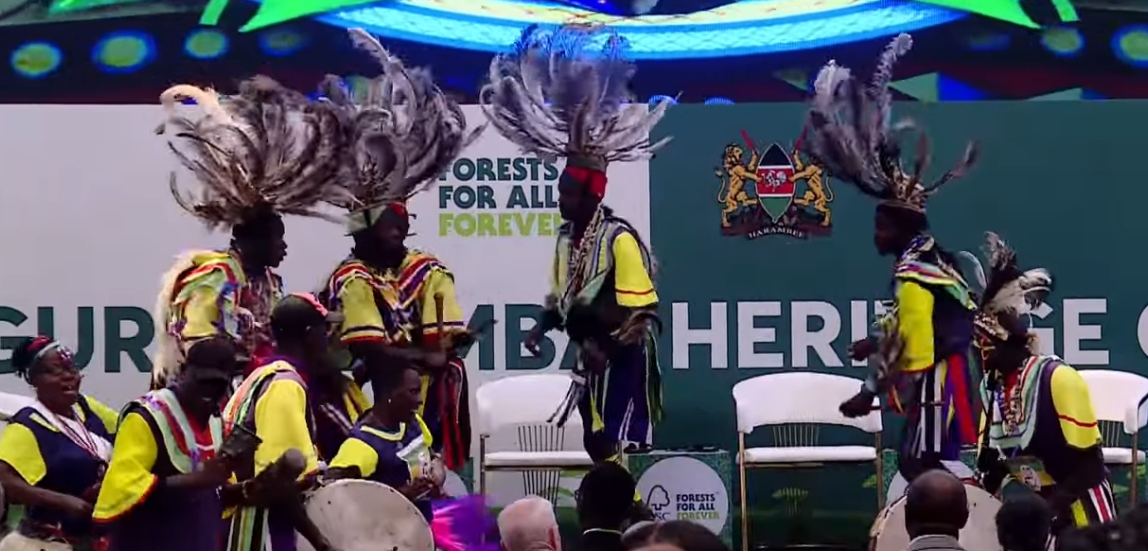
Host nation leadership: forests as environmental and economic pillars
In his opening intervention, Alex Lemarkoko, Chief Conservator of Forests at Kenya Forest Service, positioned forest stewardship as central to Kenya’s development strategy. He reaffirmed Kenya’s commitment to restore 10.6 million hectares by 2032, accelerate tree cover expansion under the 15 Billion Trees Initiative, and advance certification, including pilot certification of 60,000 hectares of gazetted public forests.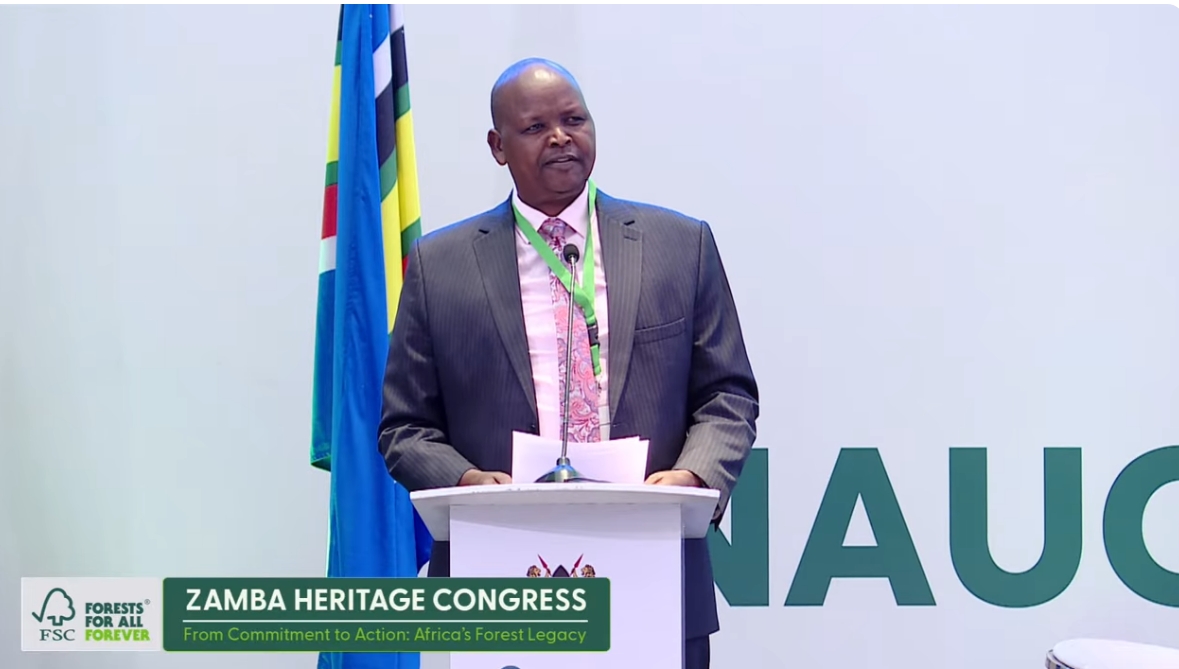
He said restoration, traceability, and certification are essential not only for environmental integrity, but for strengthening Africa’s competitiveness under the African Continental Free Trade Area (AfCFTA) and building confidence in responsibly produced African forest products. For Alex Lemarkoko the Zámba Heritage Initiative can contribute to Kenya’s sustainable forest management agenda and must be viewed as a strategic opportunity to boost economic growth and environmental resilience.
A continental vision anchored in credibility
Dr Subhra Bhattacharjee, Director-General of FSC, in her opening reaffirmed FSC’s commitment to scale responsible forest management in Africa:
“The Zámba Heritage Initiative is FSC’s stand for our shared future and our institutional commitment to action. Africa’s forests are a global public good, and how we steward them will determine not only Africa’s prosperity, but global climate trajectories. To keep these forests standing, healthy, and resilient, we must make the economics of forest management work. Our credibility and future relevance are tied to our ability to deliver real, measurable, and verifiable impact here,” said Dr Subhra Bhattacharjee, Director-General of FSC.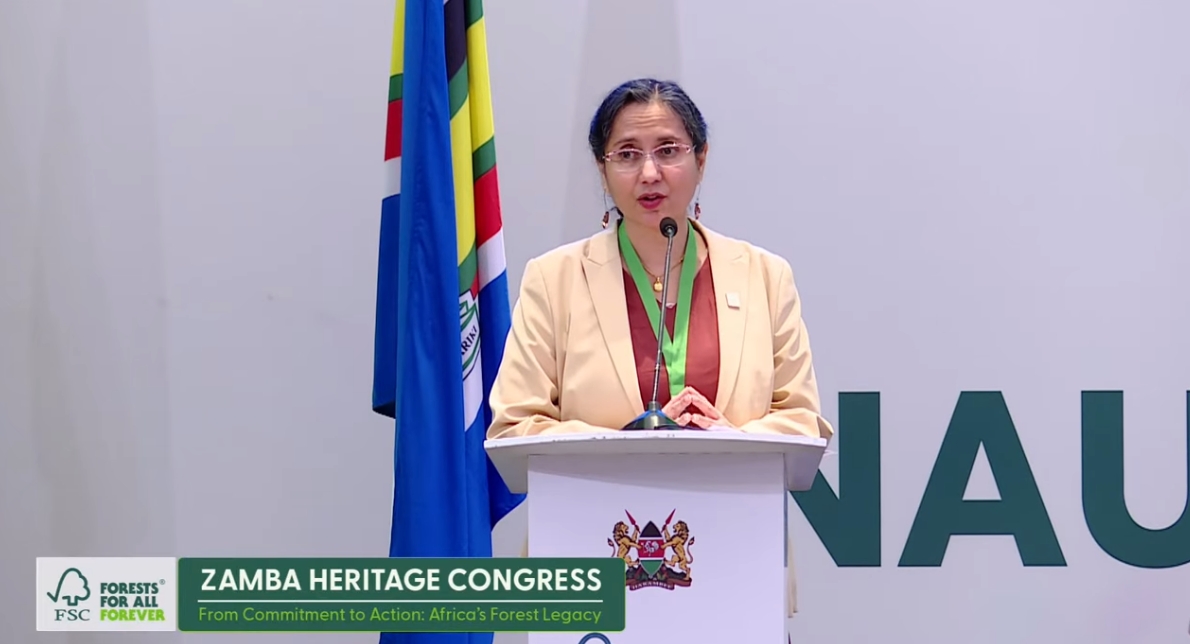
She said that FSC is backing the Zámba Heritage Initiative with concrete, mobilized resources—not solely promises.
Building on the institutional commitment, Dr Peter Alele, Regional Director for FSC Africa, provided more insights about Zámba Heritage Initiative. He said the “Zámba Heritage Initiative is an Africa-led journey to bring 30 million hectares of forest under sustainable management and restore 5 million hectares of degraded land. It is our 10-year promise to our continent.” 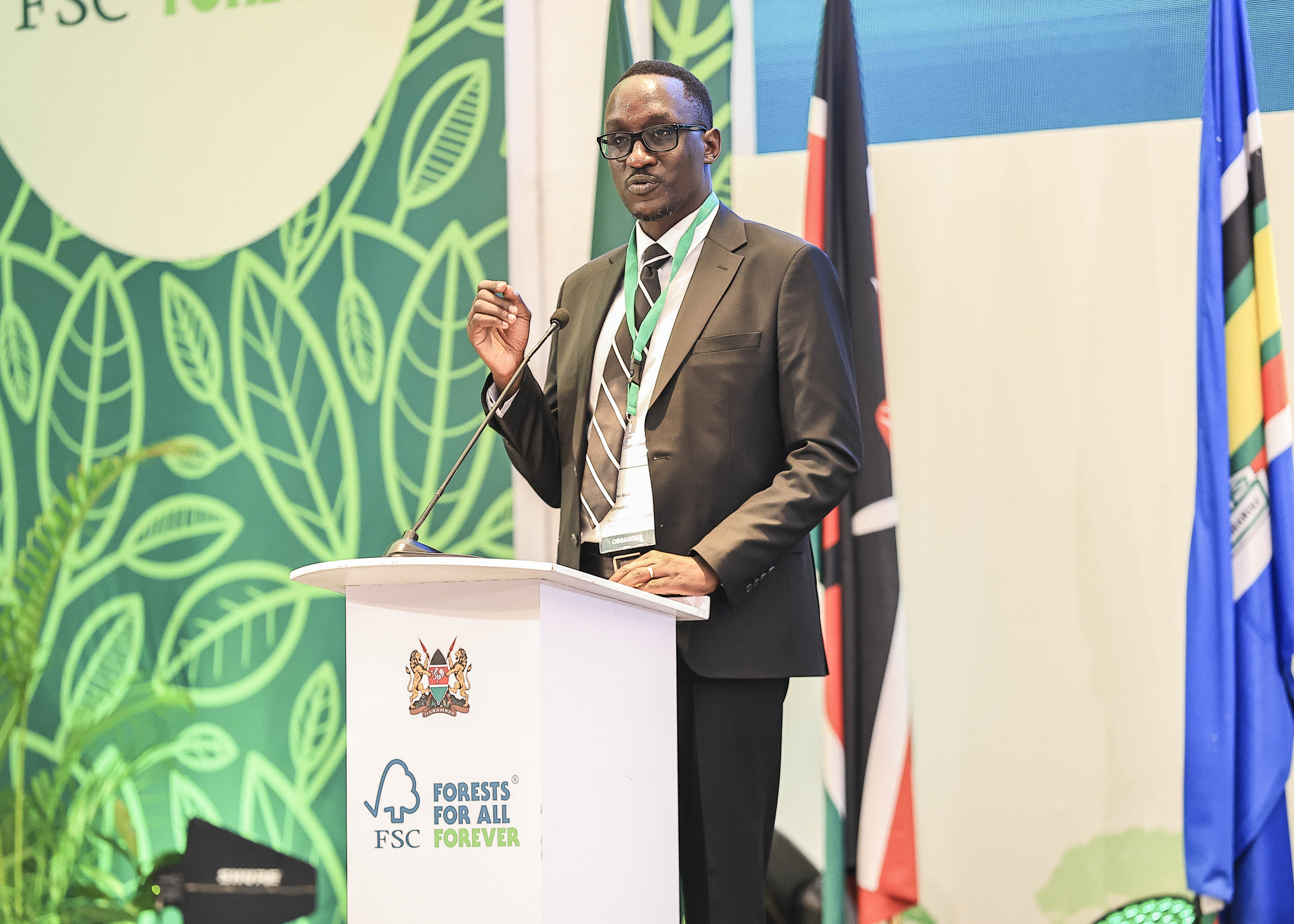
He added that Zámba’s mission is “to protect and benefit from our forests; to restore landscapes; to position African forests at the heart of global climate dialogue; and to unlock investments that uplift our people.”
Economic transformation: youth, markets and the forest bioeconomy
In his keynote address at the Zámba Heritage Congress, Prof. Labode Popoola urged Africans to believe in the power of their youth and support their entrepreneurial ventures in the forest sector, making a compelling case for positioning forestry as "Africa’s future gold."
As the Executive Secretary–CEO of the African Forests Forum and Professor of Forest Economics and Sustainable Development, Prof. Popoola argued that forests represent a vital economic frontier rather than just a conservation asset.
By 2050, Africa is projected to account for 85% of global workforce growth, with more than 830 million young people shaping the continent’s economic trajectory. With 71% of African youth aspiring to entrepreneurship, forestry presents a powerful pathway to enterprise development, landscape restoration, and sustainable value creation.
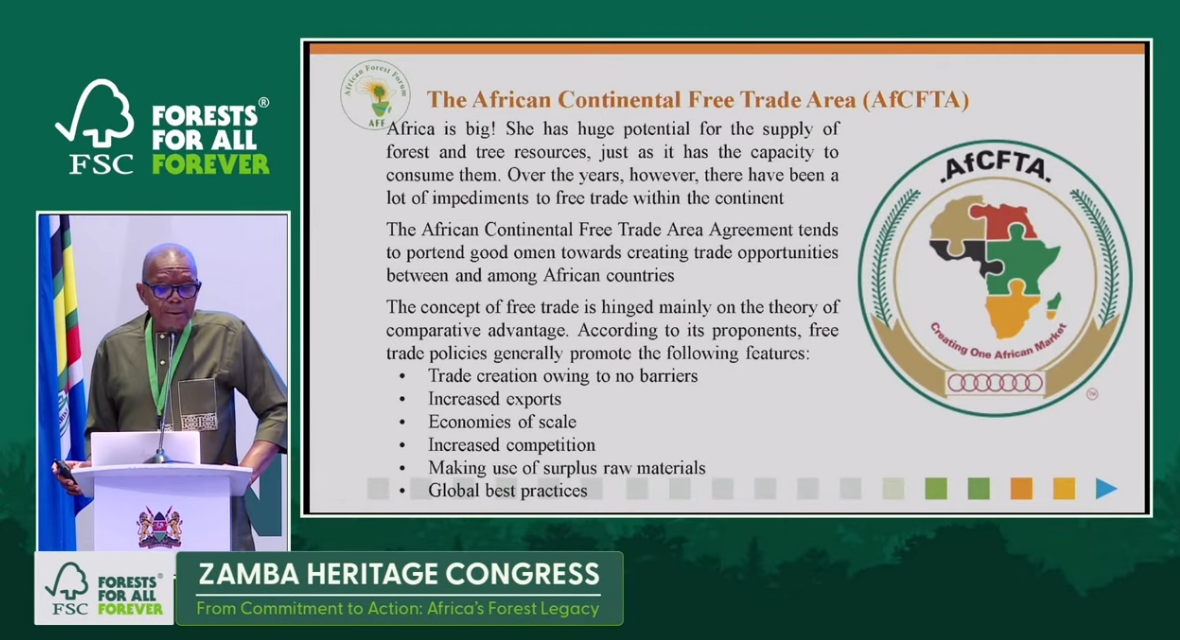 Through the African Continental Free Trade Area (AfCFTA), Africa has a historic opportunity to transition from raw timber supply chains to competitive, value-added forest economies — unlocking trade, innovation, and a thriving forest-based bioeconomy.
For Professor Labode the message is clear: if Africa’s youth are empowered with the right policies, financing instruments, technical skills, and market access, forests can fuel jobs, climate resilience, and shared prosperity for generations to come.
The economic future of conservation
In his address as the second keynote speaker at the Zámba Heritage Congress, Prof. Rhett D. Harrison framed forests as economic engines, climate allies, and biodiversity sanctuaries, exploring the vital economic future of conservation and ecosystem services.
A Senior Landscape Ecologist at ICRAF, Prof. Harrison highlighted how sustainable forest management can generate tangible value from timber, carbon credits, and emerging biodiversity markets—while simultaneously safeguarding the cultural, social, and environmental benefits that anchor these landscapes.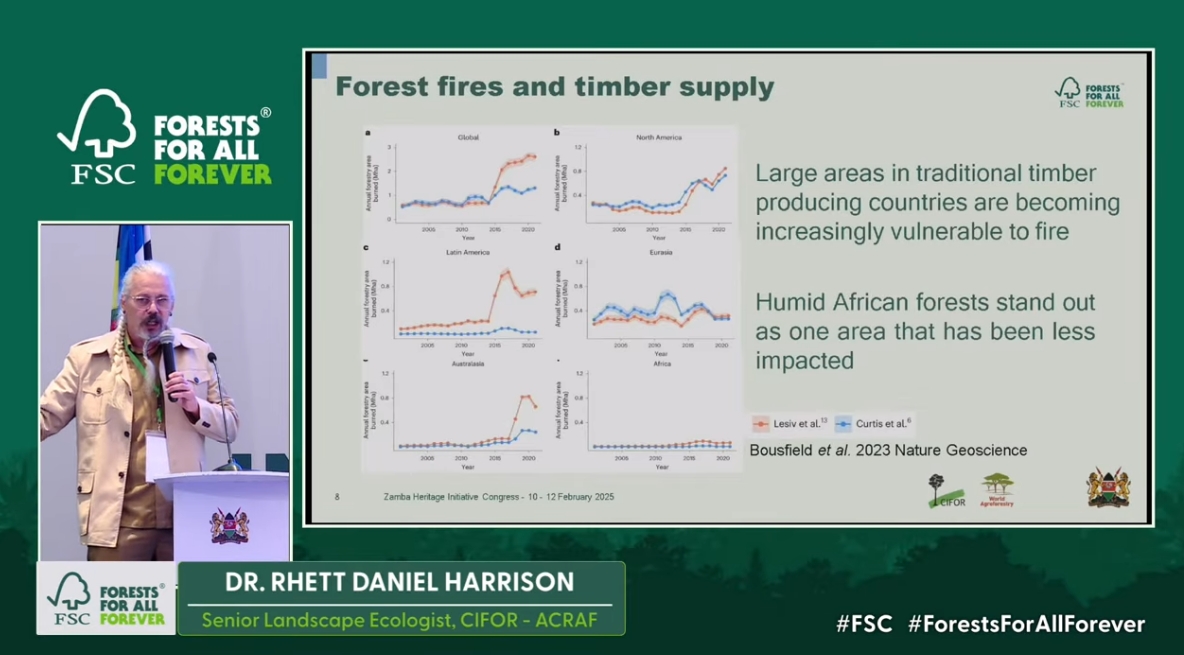
Through selective logging systems, carbon offset programs, and high-quality biodiversity conservation, Africa’s forests can deliver measurable climate mitigation, green finance opportunities, and resilient livelihoods.
Sustainable management is not simply good practice; it is a pathway to investable, scalable, and nature-positive economies.
Certification, trade and sustainable supply chains
How can certification and fair trade unlock truly sustainable forest management in Africa? This critical question was brought to the limelight during the first panel of the Zámba Heritage Congress on Certification, Trade & Sustainable Supply Chains, moderated by Dr. Harrison Ochieng Kojwang, Senior Advisor at FSC.
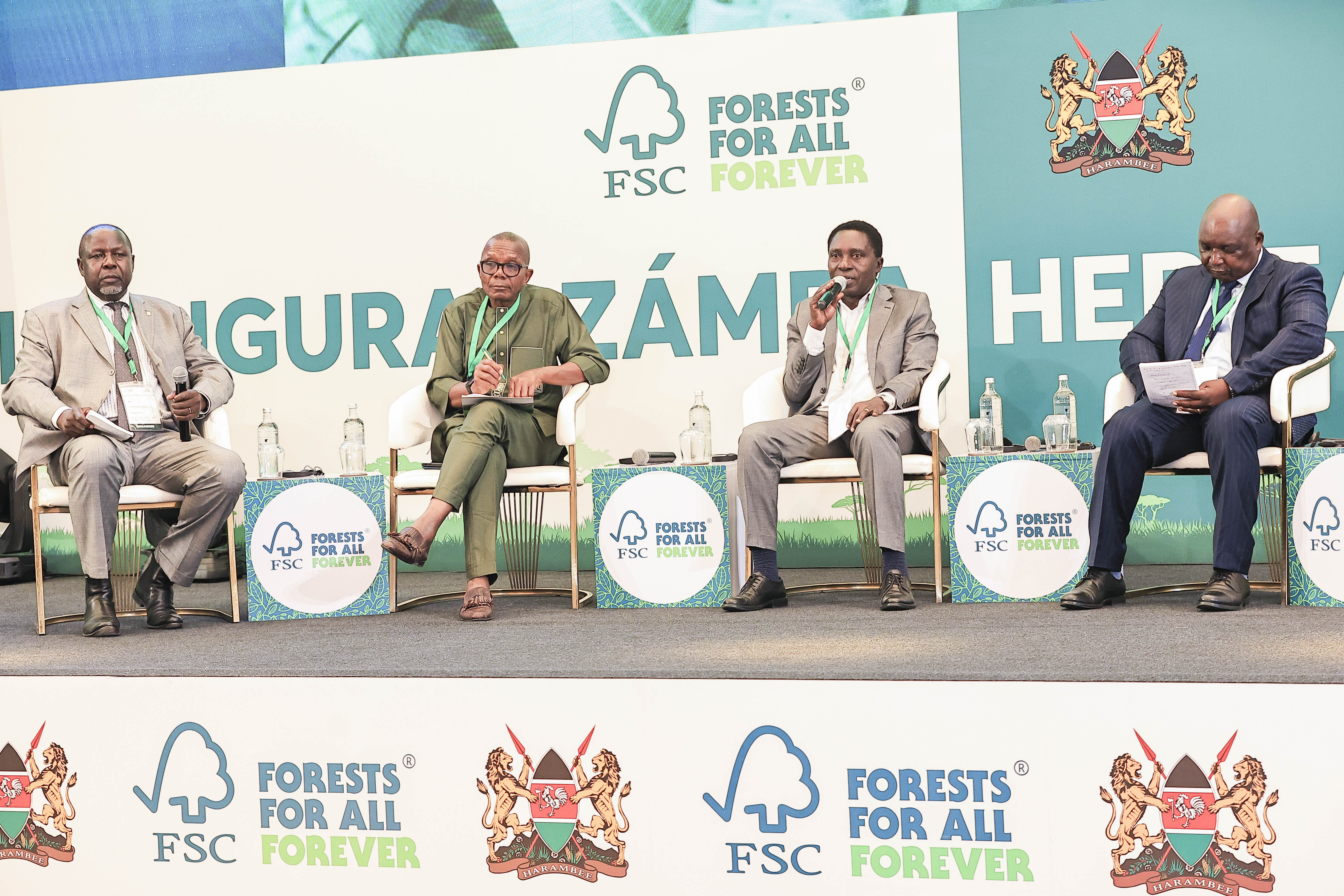
The session featured insights from Prof. Labode Popoola, Edward Mupada, and Mr Peter Gondo, and explored how responsible wood-product trade can drive sustainable management while strengthening market access.
The discussion showed that certification enhances traceability, reinforces legality, and positions African forest products competitively in regional and global markets. The conclusion was unequivocal: certification is not a barrier to trade, it is the pathway to credible markets, fair returns, and long-term sustainable forest management.
Republic of Congo: anchoring sustainability through scale and standards
The Zámba Heritage Congress provided the attending governments a platform to showcase their sustainable forest management commitments and the concrete actions they are taking to keep Africa’s forests standing for future generations.
Within this context, the Republic of Congo emerged as one of the continent’s strongest anchors for sustainable forest management and responsible timber trade.
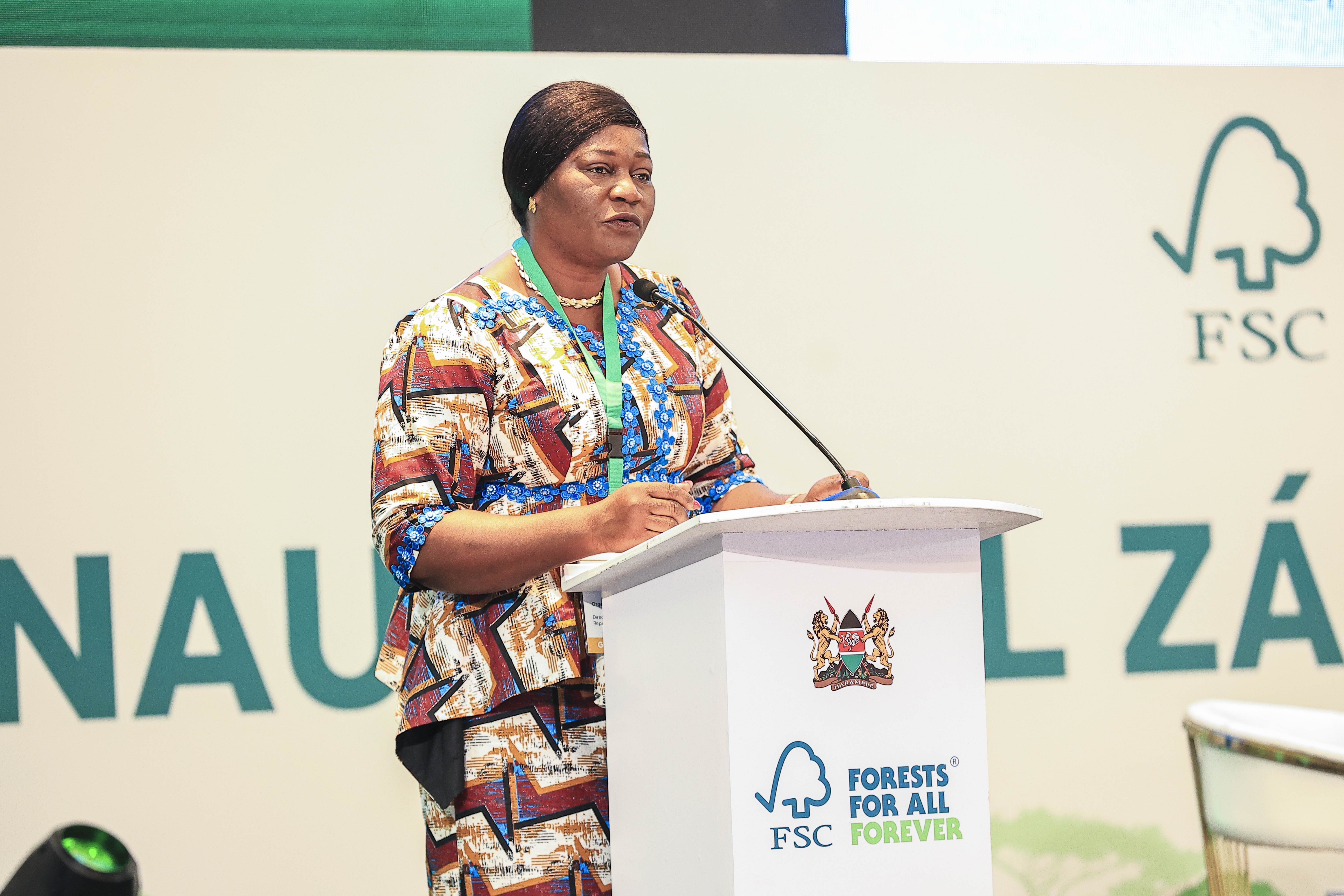
At the Congress, Paulette EBINA Taraganzo, Director of Forests, outlined a sector built on scale, structure, and standards. With approximately 65% of national territory under forest cover and over 3.5 million hectares certified — under FSC — Congo demonstrates how sustainability and competitiveness can advance together.
The country is accelerating its transition from log exports to domestic industrial transformation, expanding processing zones, and aligning its forest economy with AfCFTA, EU deforestation regulations, and global demand for legal and traceable products.
Carbon markets, plantation development, and ecosystem services are opening additional investment frontiers. Within this trajectory, Zámba Heritage strengthens Congo’s positioning — linking certified forests to regional markets, climate finance, and diversified economic growth beyond hydrocarbons.
From national pathways to continental convergence
The afternoon sessions provided a platform for more countries to speak about their ecological and climate commitments. These presentations suggested more than just a collection of isolated national priorities; they revealed a clear pattern of strategic convergence across the continent.
Governments articulated:
- Quantified restoration targets embedded in national development plans and Nationally Determined Contributions (NDCs)
- Expansion of FSC certification across public, private, and community-managed forests
- Strengthening of forest monitoring, legality assurance, and traceability systems
- Operationalization of carbon markets and Payment for Ecosystem Services (PES) mechanisms
- Integration of sustainable forest value chains into AfCFTA trade strategies
Uganda linked its restoration ambitions to Vision 2040 and regulatory reforms enabling carbon trade and ecosystem services markets. - Liberia reinforced its one-million-hectare restoration pledge, anchored in strengthened community land rights frameworks.
- Tanzania committed to scaling certification and restoring 5.2 million hectares by 2031 under its national strategy.
- Malawi reaffirmed its AFR100 commitments alongside governance reforms to address biomass dependency and deforestation drivers.
- Zambia and Zimbabwe detailed certification expansion pathways and enhanced forest monitoring systems.
- Mozambique emphasized regional cooperation through the Miombo Initiative and large-scale restoration potential.
- Kenya outlined accelerated restoration targets, certification pilots, and integration of forest products into continental trade frameworks.
Taken together, these commitments signal more than alignment, reflect a structural evolution. Sustainable forest management is no longer peripheral to national policy; it is increasingly positioned as a central pillar of climate strategy, economic planning, biodiversity protection, and regional integration across the continent.
Looking ahead
With political leadership firmly established, the Congress now turns to questions of scale, finance, and implementation. Download Day 1 pictures here.
Day 2 will focus on trade, investment pathways, and high-impact initiatives capable of translating ambition into durable.
Zamba Heritage Congress Day 1 Videos
Highlight of day 1 in a video
This is the livestream recording of Day 1